

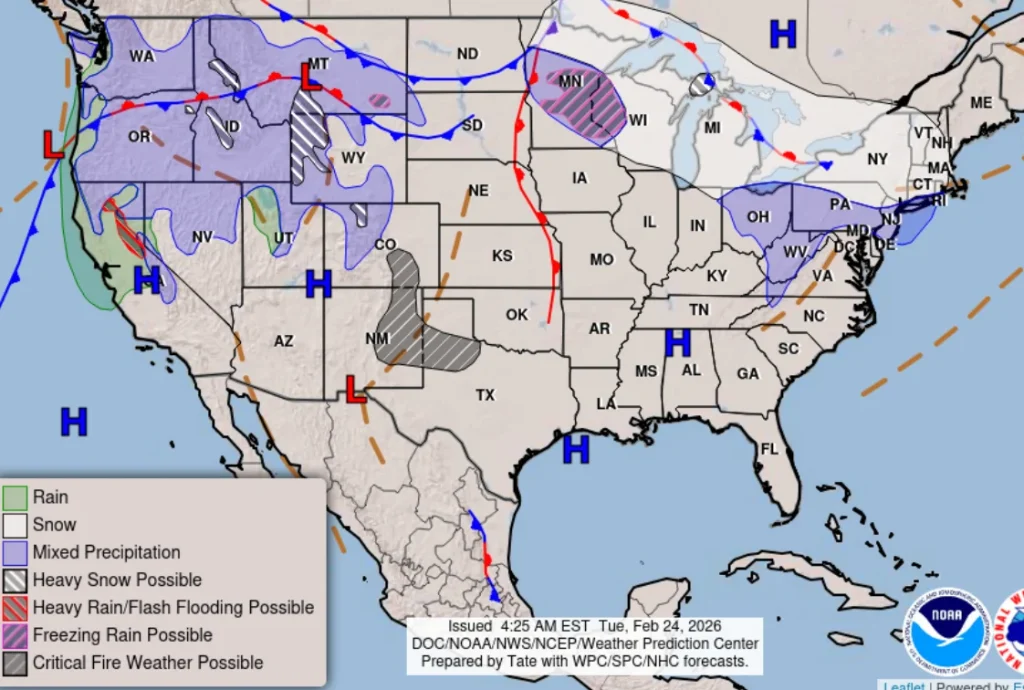
This record-setting blizzard we just had reminded me. Back in the 1950s, when I was working professionally as a meteorologist, we didn’t have computers, satellites, or any of the incredible tools that forecasters rely on today. What we had instead were surface maps, upper-air charts, a good deal of training, and experience. If I’m being honest, a fair amount of guesswork, too.
Most of the time, experience carried us through. You learned to recognize patterns, to see how systems moved, to develop a feel for what the atmosphere was likely to do next. But every so often, nature seemed to take particular pleasure in making us look foolish. We would study the charts carefully, come up with what we thought was a solid forecast, and issue it with confidence. And then, almost as if on cue, the weather would do something entirely different. Not just a little different—embarrassingly different. It was affectionately called a busted forecast.
After this happened often enough, a curious idea began to take hold. It wasn’t exactly scientific, and I wouldn’t recommend it as standard procedure, but it reflected the mood of the moment. We began to suspect, half jokingly, half seriously, that nature was somehow waiting for us to commit. As if to say, “that’ll larn ya to mess with me.” So, on occasion, we tried to outsmart it. We would prepare a forecast, put into the teletype machine and then not send it out. Instead, we would wait. Once Mama Weather had made up her mind, we could then issue the real forecast, safely avoiding whatever trick she was playing on us.
Of course, the atmosphere was not actually watching us, and it certainly wasn’t adjusting itself to prove a point. What we were running up against, though we didn’t have the language for it at the time, was the inherent unpredictability of a complex system. Today, it goes by names like chaos theory and sensitivity to initial conditions. Back then, we didn’t call it bad luck. It was a contest with that SOB the weather.
Looking back, I suspect those moments taught us something valuable, not about fooling the weather, that never worked, but about humility. The atmosphere is vast, very complicated, and under no obligation to behave the way we expect. Even now, with all the advances in technology, forecasts can still go wrong. Perhaps not as often, and not as dramatically, but enough to remind us that certainty in this business is always temporary.
Still, I sometimes wonder if we had kept those “fake forecasts” to ourselves and waited just a little longer would Mama Weather have been fooled? I’ll never know but at the time it was a plan.